An early start to hurricane season?
The Atlantic hurricane season officially begins on Wednesday, June 1, but the Caribbean is already showing signs of the change of seasons. Moisture and heavy thunderstorm activity have increased in the region between Central America and Jamaica in recent days, and rainfall amounts of 1 - 2 inches have been common over the past three days over Cuba, Hispaniola, and much of Central America. The subtropical jet stream has been bringing high wind shear of 30 - 50 knots over the Caribbean the past week, but this shear has fallen to 20 - 40 knots this morning, and is predicted to fall below 20 knots by Thursday. All of the computer models predict that an area of low pressure will form in the region between Jamaica and Honduras by Thursday. This low will have the potential to develop into a tropical depression late this week. There is some dry air over the Western Caribbean near Mexico's Yucatan Peninsula that may retard the process, but a surge of moisture accompanying a tropical wave currently passing through the Lesser Antilles may counteract this, when the wave arrives in the Western Caribbean on Thursday. Water temperatures in the Central Caribbean are about 1°C above average, 29°C, which is plenty warm enough to support development of a tropical storm. Some recent runs of the NOGPAS model have predicted development of a tropical depression by late this week, potentially affecting Jamaica and Eastern Cuba. The other models have not been as gung-ho, but have been showing the potential for a strong tropical disturbance with very heavy rains forming late this week. In any case, residents of Jamaica, Cuba, the Cayman Islands, Haiti, Honduras, and Nicaragua should anticipate the possibility that heavy rains of 2 - 4 inches may affect them Thursday through Saturday this week.

Figure 1. Total precipitable water (a measure of how much rain would fall if we condensed all the water vapor present) for May 31, 2011 at 7am EDT. Plentiful water vapor in the SW Caribbean would create about 2 inches of rain (50 mm, orange colors) if it were all condensed out. Image credit: University of Wisconsin CIMSS.
Receipt did not travel 525 miles from Joplin tornado
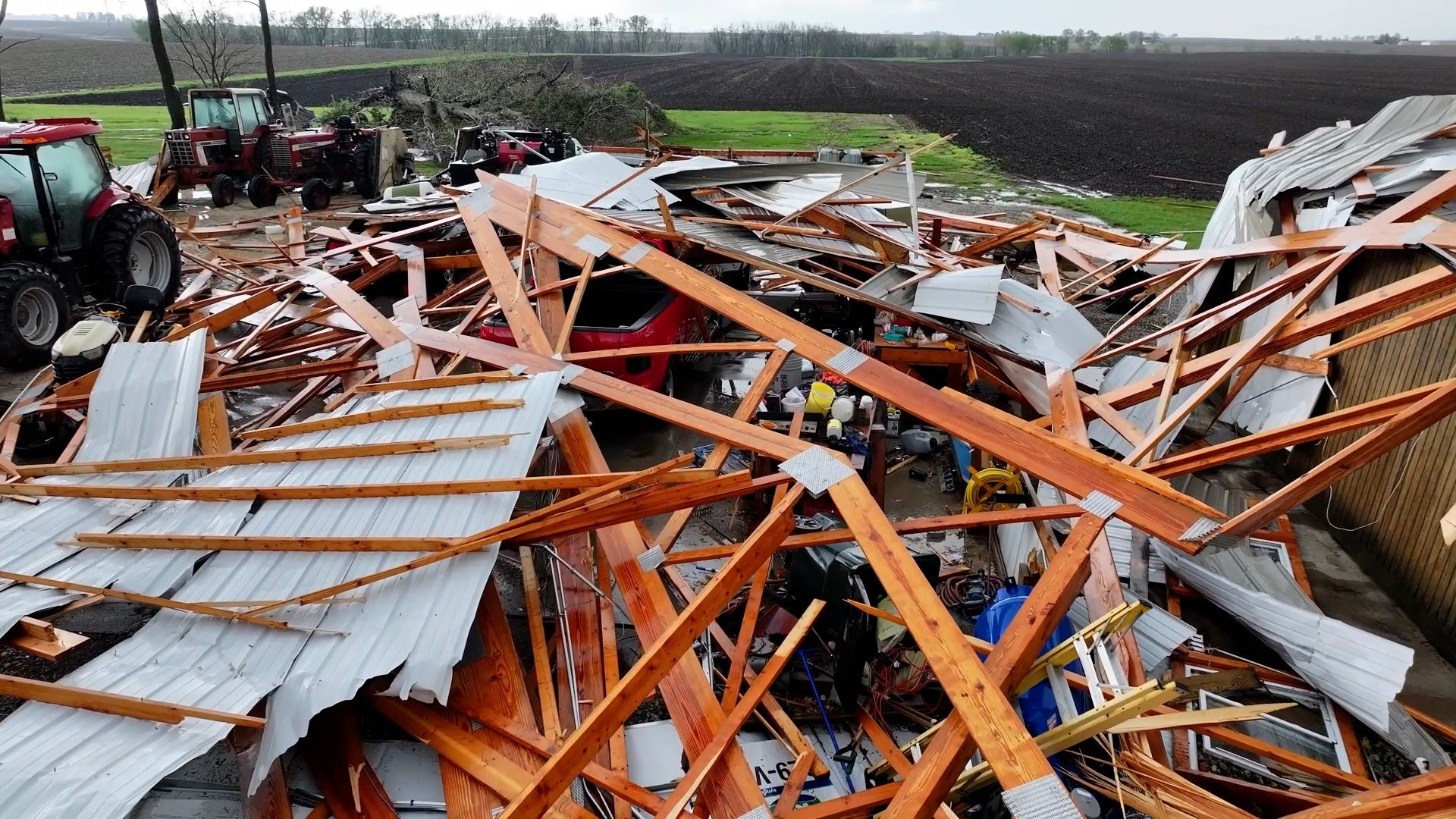
The May 22 EF-5 tornado that struck Joplin, Missouri did not set a new record for longest transport of debris by a tornado. According to MSNBC, a couple living in Royal Center, Indiana, in North Central Indiana, 525 miles from Joplin, found a receipt from the Joplin Tire store three days after the tornado hit Joplin. However, a press release from Purdue University clarified that the receipt did not arrive via the tornado, but had been left behind by a relative that had visited Joplin before the tornado. The longest distance recorded for debris from a storm was a cancelled check that traveled 210 miles after the 1915 tornado in Great Bend, Kansas.
The death toll from the May 22, 2011 tornado in Joplin, Missouri is 139, although there is still considerable uncertainty about this number. The Joplin tornado is the 8th deadliest in U.S. history, and the most deadly since the 1947 Woodward, Oklahoma twister that killed 181 people. The tornado season of 2011 now has approximately 520 deaths, which would make it the deadliest tornado season since 1936, according to statistics compiled by NOAA. In the 1936 tornado season 552 people died, mostly because of violent tornadoes that hit Tupelo Mississippi (216 killed), and Gainesville, Georgia (203 killed.)

Figure 2. Satellite image taken at 23:45 UTC (7:45pm EDT) May 22, 2011, showing the line of tornadic thunderstorms that spawned the Joplin tornado. Image credit: NOAA Visualization Laboratory.
Jeff Masters
Reader Comments
Page: 1 | 2 | 3 | 4 | 5 | 6 | 7 | 8 | 9 | 10 | 11 | 12 | 13 | 14 | 15 | 16 | 17 | 18 | 19 | 20 | 21 | 22 | 23 | 24 | 25 | 26 | 27 | 28 | 29 | 30 | 31 | 32 | 33 | 34 | 35 | 36 | 37 | 38 | 39 | 40 | 41 | 42 | 43 | 44 — Blog Index
LOL, good one TropA13,....and hello there Grothar, scorcher here today...still dry as ever there?
The brackets are actually these: < and there are no spaces.
Notice the very progressive upper pattern over the United States, with a deep-layered trough over the central to high plains advancing eastward, along with a rebuilding of the western Atlantic ridge to the east in the wake of another strong trough near Bermuda.
Of course, I've yet to see any sort of actual consistency with the models regarding any track type scenario, but still, food for thought.
That's how I think it will track.
I hope so, but I’m not holding my breath.
Sure hope that blob approaching from the Atlantic will blossom into something much larger -- and that the nearby upper-level low isn't going to keep it away from us or tear it apart.
Does anyone know if the blob in the Atlantic is supposed to cross Northern Florida, or Central, or - ? And where is the Florida-Straits upper-level low headed? BTW, I'm afraid to get excited about the low in the Caribbean, as I'm so sure it'll get snatched out into the Atlantic without hitting us here in SW Florida.
Living for the day we finally get to rainy season....
This calls for the chart, the shower curtain, and the hebert boxes.
I'd think about this intensity seriously if the CMC didn't make everything a hurricane. Though the UKMET seems to lend a second opinion to the track idea, so it's a possibility.
Well it's a bit too early to judge the strength and amplitude of the trough meteorologically. As we get closer in time, we will have a better idea as to the eventual outcome.
The what?
Don't spread misinformation.
BUT IM EXCITED!!!!!!
yup
Exactly.
We are relying too much on model guidance when the storm hasn't even been tagged as an invest.
The models have changed greatly throughout the days. I'd wait till a defined low pressure is shown and at least till the storm becomes an invest.
You said the C word!
I think UKMET has been the most consistent model so far having this.
ALL HAIL THE CHART
Not sure if this is a serious question, but there is no way that any human can answer that question at this time, lol.
Have you seen the blobs?
Why ever not?!?!?!?!?! The rest of us will be...
We still love you. ;)
So IT IS a blob.
You seem to be changing your story...which is it? :S
You seriously underestimate the special Powers of the Blog!!!!!!
Circulation is more evident too.
Not hot, but still very dry. Not a drop. How you been EYES?
You have some special powers too that I cannot fathom. ;D
My my, hey hey
Rock and roll is here to stay
It's better to burn out
Than to fade away
My my, hey hey.
Out of the blue and into the black
They give you this, but you pay for that
And once you're gone, you can never come back
When you're out of the blue and into the black.
The king is gone but he's not forgotten
This is the story of a johnny rotten
It's better to burn out than it is to rust
The king is gone but he's not forgotten.
Hey hey, my my
Rock and roll can never die
There's more to the picture
Than meets the eye.
Hey hey, my my.
Yes, I notice it every time I start walking around. It helps a lot.
Or are you referring to one of the blobs.
OK...I don't care who ya are....THAT'S funny....
Blob and blobette do not refer to gender, but to size. A blobette is a small blob.
and the water temperatures are at least borderline. What am I missing?
Viewing: 951 - 1001
Page: 1 | 2 | 3 | 4 | 5 | 6 | 7 | 8 | 9 | 10 | 11 | 12 | 13 | 14 | 15 | 16 | 17 | 18 | 19 | 20 | 21 | 22 | 23 | 24 | 25 | 26 | 27 | 28 | 29 | 30 | 31 | 32 | 33 | 34 | 35 | 36 | 37 | 38 | 39 | 40 | 41 | 42 | 43 | 44 — Blog Index